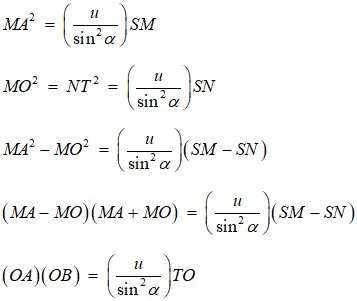
Parabola 11 SupportConstruct a parabola through four given points. See the book 100 Great Problems of Elementary Mathematics: Their History and Solution by Heinrich Dörrie. This is problem 45. The author begins by citing two solutions by Newton. That is, he cites two publications without actually specifying where this problem comes up. Those turned out to be Principia, Book I, Proposition 27, Scholium; and Arithmetica Universalis, Geometrical Questions, Problem LVIII. The Principia solution was not as clear as I might have wished, while a translation of Arithmetica was much more difficult to locate and turned out to be even less helpful. I may have learned why Newton himself objected to its publication. Meanwhile, Dörrie’s own explanation is clear and concise. I am adapting it below. First consider the four given points. They must be subject to certain conditions. Suppose a triangle is inscribed in a parabola. Without going into rigorous proof here, it clearly is not possible for any part of the parabola to fall on the interior of that triangle. It follows, then, that any four points on a parabola must be vertices of a convex quadrilateral. Another condition is that this quadrilateral cannot be a parallelogram, because no parabola can have two chords that are both parallel and equal in length. Start from those conditions. A certain proposition from Apollonius will be required. 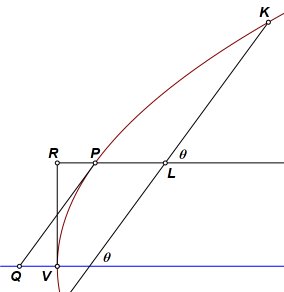 In this sketch let point V be the axial vertex of a parabola. Let PQ be tangent to the parabola at P, meeting the axis at Q. Line segment KL is an ordinate to diameter RPL, hence parallel to PQ, and RV is perpendicular to the axis. Let KL intersect the axis (and all diameters) at angle θ. Let u be the latus rectum of the parabola.  From Conica (I, 49), this follows:  That was a general case. Starting fresh now, let a new parabola have chord AB, with point O on the chord. Let M be the midpoint of AB, and let S be the vertex of diameter SM, which makes AM an ordinate to that diameter. From point T on the curve, TO is parallel to the axis and TN is an ordinate to SM. Chord AB intersects the axis at angle α. Let the latus rectum again be called u. 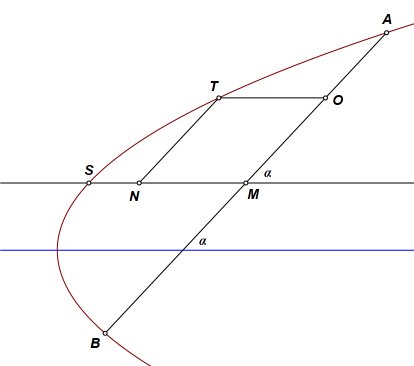
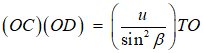
Now, let chord CD also pass through O, and let it intersect the axis at angle β. Similarly, this relationship follows: 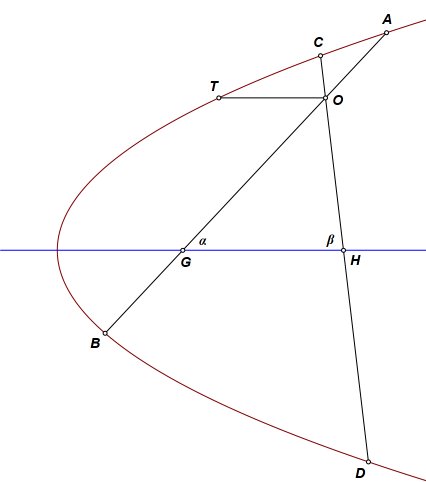
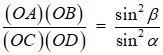
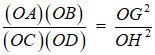
Let the axis meet AB at G and CD at H. Apply the rule of sines to ΔOGH. 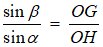
Thus, OG and OH are in the ratio of the geometric means of the segments into which AB and CD are divided by point O. To complete the construction divide AOB at point E, so that OE is equal to the geometric mean of OA and OB. Divide COD at points F1 and F2, so that OF1 and OF2 are both equal to the geometric mean of OC and OD. A parabola through A, B, C, and D must have an axis parallel to EF1 or EF2. 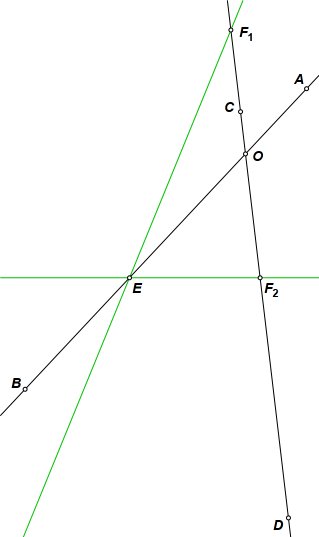 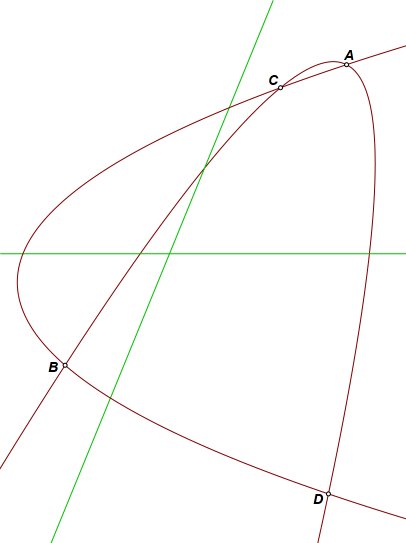 Note that only one division point (E) was constructed on AOB. The second point would have resulted in two redundant lines, parallel to those constructed here. Also, understand that these two constructed lines are diameters of two solutions. They generally are not axes. In these illustrations lines AB and CD are diagonals of the quadrilateral. That is not actually necessary. They can be opposite sides, but the points must form a convex quadrilateral, and it must not be a parallelogram. For completion of the solutions, see the challenge Parabola 9, a parabola given any diameter and three points on the curve. Last update: May 13, 2026 ... Paul Kunkel whistling@whistleralley.com |